

O’Connor Emmet Accountants & Tax Advisers
  • Home
  • About Us
  • International Tax
  • Australian Tax
  • Irish Tax
  • Business Services
  • Latest News
  • Contact Us
  • Book a Consultation
  • Click to open the search input field Click to open the search input field Search
  • Menu Menu

The 2025 Financial Year tax & super changes you need to know!

The new financial year is fast approaching and so are a number of changes to superannuation contribution amounts and the individual tax rates. These changes are outlined below, as is some information on how you may be able to work with these changes when managing your tax affairs during 2024-25.

 

.


Superannuation

From 1 July 2024, the amount you can contribute to super will increase.

The amount you can contribute to superannuation will increase on 1 July 2024 from $27,500 to $30,000 for concessional super contributions and from $110,000 to $120,000 for non-concessional contributions.

For those with the disposable income to contribute, superannuation can be very attractive with a 15% tax rate on concessional super contributions and potentially tax-free withdrawals when you retire. For business owners who might have had an exceptional year or sold their business, it's an opportunity to get more into super. However, the timing of contributions will be important to maximise outcomes.

If you know you will have a capital gains tax liability in a particular year, you may be able to use ‘catch up’ contributions to make a larger than usual contribution and use the tax deduction to help offset your capital gain tax bill. But, this strategy will only work if you meet the eligibility criteria to make catch up contributions and you lodge a Notice of intent to claim or vary a deduction for personal super contributions, with your super fund.

Using the bring forward rule

This topic has been touched on in previous articles but the ‘bring forward rule’ enables you to bring forward up to 2 years’ worth of future non-concessional contributions into the year you make the contribution – this is assuming your total superannuation balance enables you to make the contribution and you are under age 75.

If you utilise the bring forward rule before 30 June 2024, the maximum that can be contributed is $330,000. However, if you wait to trigger the bring forward until on or after 1 July 2024, then the maximum that can be contributed under this rule is $360,000.

‘Catch up’ contributions

If your super balance is below $500,000 prior to 30 June, and you want to quickly increase the amount you hold in super, you can utilise any unused concessional super contributions amounts from the last 5 years.

For example, a taxpayer has only been using $15,000 of the concessional super cap for the last few years. The super balance at 30 June 2023 was $300,000, so this person is well within the limit to make catch up contributions.
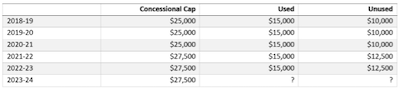
A table with numbers and textDescription automatically generated

This person could access their $27,500 concessional cap for 2023-24 plus the unused $55,000 from the prior 5 financial years.
However, if the unused amount from 2018-19 is not used by 30 June 2024, the $10,000 will no longer be available.

Taxation

As we all know, the revised stage 3 tax cuts have passed Parliament and will come into effect on 1 July 2024. The following table outlines what the rates currently are and what they will be from the 2025 financial year.
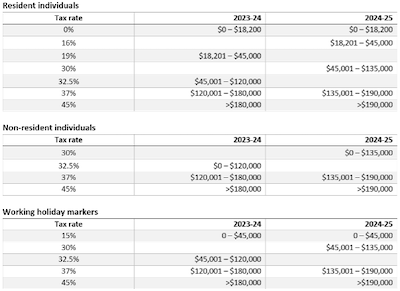
A table of income taxDescription automatically generated with medium confidence


Salary sacrifice agreements should be checked before the new tax rates come into effect to ensure they will continue to produce the result you are after.

Be sure to contact us if you have any concerns or questions.

Share this entry
  • Share on WhatsApp
https://irishtax.com.au/wp-content/uploads/2024/04/tax-substantiation.jpg 300 450 darkroom https://irishtax.com.au/wp-content/uploads/2022/07/oconnoremmet.png darkroom2024-04-18 00:00:002024-04-02 14:16:52The 2025 Financial Year tax & super changes you need to know!

Recent Posts

  • 2026 Year-End Tax Planning Guide – Part 1 June 10, 2026
  • From Bricks to iPhones: The Evolution of the Telephone May 30, 2026
  • Succession planning and why it should be at the top of your to-do list May 28, 2026
  • Choosing the right trustee structure for your SMSF May 25, 2026
  • ATO taking a closer look at investment properties May 23, 2026
  • Major super tax changes now law May 21, 2026
  • RSM welcomes updated PCG on transfer pricing for inbound distributors May 17, 2026
  • ATO reminds practitioners to avoid common FBT mistakes May 13, 2026
  • Why every business should have an AI policy May 10, 2026
  • Most Valuable Industries in the World 2026 April 30, 2026
  • Buy an existing business April 28, 2026
  • Fringe Benefits Tax (FBT) Guide – Key Checklist & Rates April 25, 2026
  • Succession planning to remain major focus for ATO this year April 23, 2026
  • Strategies for Effective Debt Recovery for Small Businesses April 21, 2026
  • ATO issues new guidance on penalties for non-compliance with STP April 17, 2026
  • Payday Super: 6 Things Small Businesses Need to Know April 13, 2026
  • Inflation continues to keep SME owners up at night, survey finds April 10, 2026
  • Most Reliable Car Brands in 2026 March 30, 2026
  • Calculate your costs to start a business March 28, 2026
  • Are you ready for Payday superannuation? March 25, 2026
Search Search

Recent Posts

  • 2026 Year-End Tax Planning Guide – Part 1
  • From Bricks to iPhones: The Evolution of the Telephone
  • Succession planning and why it should be at the top of your to-do list
  • Choosing the right trustee structure for your SMSF
  • ATO taking a closer look at investment properties

Archives

  • June 2026
  • May 2026
  • April 2026
  • March 2026
  • February 2026
  • January 2026
  • December 2025
  • November 2025
  • October 2025
  • September 2025
  • July 2025
  • June 2025
  • May 2025
  • April 2025
  • March 2025
  • February 2025
  • January 2025
  • December 2024
  • November 2024
  • October 2024
  • September 2024
  • August 2024
  • July 2024
  • June 2024
  • May 2024
  • April 2024
  • March 2024
  • February 2024
  • January 2024
  • December 2023
  • November 2023
  • October 2023
  • September 2023
  • August 2023
  • November 2022
  • October 2022
  • September 2022
  • August 2022
  • July 2022
  • June 2022
  • May 2022
  • April 2022
  • March 2022
  • February 2022
  • January 2022
  • December 2021
  • November 2021
  • October 2021
  • September 2021
  • August 2021
  • July 2021
  • June 2021
  • May 2021
  • April 2021
  • March 2021
  • February 2021
  • January 2021
  • December 2020
  • November 2020
  • October 2020
  • September 2020
  • August 2020
  • July 2020
  • April 2019
  • March 2019
  • December 2018
  • October 2018
  • June 2018
  • May 2018
  • March 2018
  • December 2017
  • October 2017
  • September 2017
  • August 2017
  • July 2017
  • June 2017
  • May 2017
  • April 2017
  • October 2016
  • September 2016
  • August 2016
  • June 2016
  • May 2016
  • March 2016
  • December 2015
  • November 2015
  • October 2015
  • August 2015
  • July 2015
  • June 2015
  • May 2015
  • March 2015
  • February 2015
  • January 2015
  • December 2014
  • November 2014
  • October 2014
  • September 2014
  • August 2014
  • July 2014
  • June 2014
  • May 2014
  • December 2013
  • November 2013
  • October 2013
  • September 2013
  • August 2013
  • July 2013

Categories

  • Accounting News
  • Uncategorized

Meta

  • Log in
  • Entries feed
  • Comments feed
  • WordPress.org

O’Connor Emmet Accountants & Tax Advisers

Tax Agent No. 26033744

Telephone: +61 02 8324 7433
Email: info@oconnoremmet.com.au
Facebook: https://www.facebook.com/oconnoremmetaccountants/

Liability limited by a Scheme approved under Professional Standards Legislation.

Links

  • Australian Tax
  • Office of the Revenue Commissioners
  • Irish Taxation Institute
  • Tax Institute of Australia
  • Association of Chartered Certified Accountants
  • Australian Taxation Office
© Copyright - O’Connor Emmet Accountants & Tax Advisers - Website by Web and Print Design
Link to: Small business benchmarks Link to: Small business benchmarks Small business benchmarks Link to: Underperforming employees: When can you terminate? Link to: Underperforming employees: When can you terminate? Underperforming employees: When can you terminate?
Scroll to top Scroll to top Scroll to top