

O’Connor Emmet Accountants & Tax Advisers
  • Home
  • About Us
  • International Tax
  • Australian Tax
  • Irish Tax
  • Business Services
  • Latest News
  • Contact Us
  • Book a Consultation
  • Click to open the search input field Click to open the search input field Search
  • Menu Menu

Super, death, and taxes


An interesting finding in the federal government's Retirement Income Review report is that many Australians are dying with the majority of the wealth they had when they retired.



Having enough superannuation to enjoy a financially comfortable lifestyle in retirement is the aspiration of most Australians.

As the super system continues to mature, and with the benefit of compounding investment returns, average retirement savings balances are rising.

But an interesting finding in the federal government's just-released Retirement Income Review final report is that many Australians are dying with the majority of the wealth they had when they retired.

Concerned about outliving their superannuation savings, the report found that the majority of retirees tend to spend less rather than use financial products to better manage their longevity risk.

In other words, rather than wanting to spend up, many retirees are keen to watch their savings balance grow.

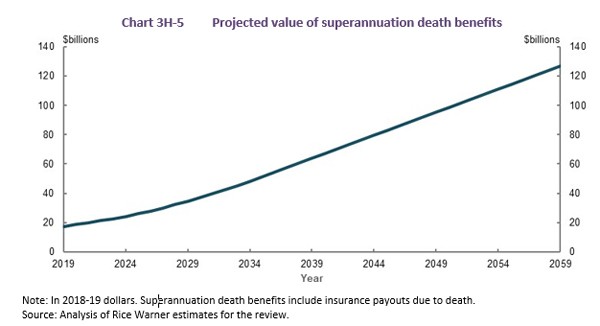
And that's pointing towards a huge blow-out in the payment of super death benefits, which actuarial firm Rice Warner projects in the Retirement Income Review report will rise from the current level of around $17 billion per annum to just under $130 billion by 2059.

Projected value of superannuation death benefits
Unintended consequences

When there's superannuation still left over at the end of your life, it's most commonly inherited by your surviving spouse or children, or bequeathed to other nominated beneficiaries.

If you don't have a spouse, and intend to leave your super to your adult children, there may be serious tax consequences for them.

It all comes down to whether your beneficiaries are entitled to access your super funds tax free or not after you're deceased.

So, having an understanding of the tax rules around super death benefits is extremely useful. With proper estate planning before you die, it may be possible to reduce your after-death super tax liabilities.

The tax rules around super death benefits

While there is no formal inheritance tax in Australia, super death benefits are taxed in some cases.

Essentially, superannuation can only be passed on tax-free when it is left to a spouse or dependant children under the age of 18.

A death benefit dependant, as determined by the Tax Act, can also include de factos, former spouses, those with whom you have shared an interdependency relationship immediately prior to death, and others who were financially dependent on you just before you died.

Beneficiaries who fall outside of these parameters, such as adult children, are often caught up in the ATO's tax dragnet.

Superannuation benefits are generally comprised of both taxable and tax-free funds, based on the nature of contributions that have been made over time.

Those contributions made by your employer at the concessional tax rate of 15 per cent form part of the taxable component, while after-tax contributions made by you separately as non-concessional contributions make up the tax-free component.

It's the taxable component – usually where the bulk of an individual's super funds reside – that will carry the tax liability for any adult children receiving your super payout on your death.

Avoiding an after-death tax experience

Transferring super wealth is a non-issue from a tax perspective if you have a spouse or dependant children to leave it to.

If you don't, there are ways to reduce your potential super tax burden for non-dependent beneficiaries.

One of them is through the use of what's known as a super recontribution strategy.

If you've reached an age where you can legally access your funds, this enables you to draw out the taxable component of your super as a lump sum and then recontribute it back into your super fund in the form of after-tax contributions.

Any taxable super withdrawn will be liable for tax at your marginal tax rate, however if you are aged over 60 and have stopped working (are retired) then your marginal tax rate is effectively zero.

Current laws allow individuals to contribute up to $100,000 per financial year as non-concessional (tax-paid) contributions, or up to $300,000 in one year using what's known as the three-year bring forward rule.

Keep in mind however that there are restrictions on personal super contributions for those aged 67 and above.

Using a recontribution strategy can effectively reduce or eliminate the taxable portion of your super, meaning non-dependant beneficiaries of your super may not have to pay any tax if it's received as a lump sum after your death.

Careful planning

When you're looking at who you want to leave your super to, it's very important you consider things carefully as some proper planning needs to be done.

Without planning there could be some unexpected and significant taxes bestowed upon your heirs, which could be exacerbated if any life insurance payout from your super fund is made to someone who is not a spouse or dependant.

To discuss your estate planning needs, including around your super death benefits and potential tax liabilities, it's important to consult a licensed financial adviser.


By Tony Kaye
Senior Personal Finance Writer
Vanguard Australia
01 Dec, 2020


Share this entry
  • Share on WhatsApp
https://irishtax.com.au/wp-content/uploads/2020/12/super20death20taxes.jpg 316 475 darkroom https://irishtax.com.au/wp-content/uploads/2022/07/oconnoremmet.png darkroom2020-12-19 00:00:002020-12-03 09:40:00Super, death, and taxes

Recent Posts

  • Check out what Uses the Most Internet Traffic: Data from 1994 to 2026 June 30, 2026
  • Managing your mental health and wellbeing during times of uncertainty June 29, 2026
  • 6 tips to help businesses avoid financial difficulties June 28, 2026
  • SMEs to be hit hardest by new trust tax reforms June 23, 2026
  • Payday Super: 6 Things Small Businesses Need to Know June 21, 2026
  • PAYDAY SUPER STARTS 1 JULY 2026 – Planning guides June 17, 2026
  • 2026 Year-End Tax Planning Guide – Part 2 June 13, 2026
  • 2026 Year-End Tax Planning Guide – Part 1 June 10, 2026
  • From Bricks to iPhones: The Evolution of the Telephone May 30, 2026
  • Succession planning and why it should be at the top of your to-do list May 28, 2026
  • Choosing the right trustee structure for your SMSF May 25, 2026
  • ATO taking a closer look at investment properties May 23, 2026
  • Major super tax changes now law May 21, 2026
  • RSM welcomes updated PCG on transfer pricing for inbound distributors May 17, 2026
  • ATO reminds practitioners to avoid common FBT mistakes May 13, 2026
  • Why every business should have an AI policy May 10, 2026
  • Most Valuable Industries in the World 2026 April 30, 2026
  • Buy an existing business April 28, 2026
  • Fringe Benefits Tax (FBT) Guide – Key Checklist & Rates April 25, 2026
  • Succession planning to remain major focus for ATO this year April 23, 2026
Search Search

Recent Posts

  • Check out what Uses the Most Internet Traffic: Data from 1994 to 2026
  • Managing your mental health and wellbeing during times of uncertainty
  • 6 tips to help businesses avoid financial difficulties
  • SMEs to be hit hardest by new trust tax reforms
  • Payday Super: 6 Things Small Businesses Need to Know

Archives

  • June 2026
  • May 2026
  • April 2026
  • March 2026
  • February 2026
  • January 2026
  • December 2025
  • November 2025
  • October 2025
  • September 2025
  • July 2025
  • June 2025
  • May 2025
  • April 2025
  • March 2025
  • February 2025
  • January 2025
  • December 2024
  • November 2024
  • October 2024
  • September 2024
  • August 2024
  • July 2024
  • June 2024
  • May 2024
  • April 2024
  • March 2024
  • February 2024
  • January 2024
  • December 2023
  • November 2023
  • October 2023
  • September 2023
  • August 2023
  • November 2022
  • October 2022
  • September 2022
  • August 2022
  • July 2022
  • June 2022
  • May 2022
  • April 2022
  • March 2022
  • February 2022
  • January 2022
  • December 2021
  • November 2021
  • October 2021
  • September 2021
  • August 2021
  • July 2021
  • June 2021
  • May 2021
  • April 2021
  • March 2021
  • February 2021
  • January 2021
  • December 2020
  • November 2020
  • October 2020
  • September 2020
  • August 2020
  • July 2020
  • April 2019
  • March 2019
  • December 2018
  • October 2018
  • June 2018
  • May 2018
  • March 2018
  • December 2017
  • October 2017
  • September 2017
  • August 2017
  • July 2017
  • June 2017
  • May 2017
  • April 2017
  • October 2016
  • September 2016
  • August 2016
  • June 2016
  • May 2016
  • March 2016
  • December 2015
  • November 2015
  • October 2015
  • August 2015
  • July 2015
  • June 2015
  • May 2015
  • March 2015
  • February 2015
  • January 2015
  • December 2014
  • November 2014
  • October 2014
  • September 2014
  • August 2014
  • July 2014
  • June 2014
  • May 2014
  • December 2013
  • November 2013
  • October 2013
  • September 2013
  • August 2013
  • July 2013

Categories

  • Accounting News
  • Uncategorized

Meta

  • Log in
  • Entries feed
  • Comments feed
  • WordPress.org

O’Connor Emmet Accountants & Tax Advisers

Tax Agent No. 26033744

Telephone: +61 02 8324 7433
Email: info@oconnoremmet.com.au
Facebook: https://www.facebook.com/oconnoremmetaccountants/

Liability limited by a Scheme approved under Professional Standards Legislation.

Links

  • Australian Tax
  • Office of the Revenue Commissioners
  • Irish Taxation Institute
  • Tax Institute of Australia
  • Association of Chartered Certified Accountants
  • Australian Taxation Office
© Copyright - O’Connor Emmet Accountants & Tax Advisers - Website by Web and Print Design
Link to: JobMaker hiring credit given green light despite ongoing concerns Link to: JobMaker hiring credit given green light despite ongoing concerns JobMaker hiring credit given green light despite ongoing concerns Link to: ATO extends JobKeeper deadlines ahead of Christmas Link to: ATO extends JobKeeper deadlines ahead of Christmas ATO extends JobKeeper deadlines ahead of Christmas
Scroll to top Scroll to top Scroll to top